Who’s a Qualified Translator
In F2575, a qualified translator is always a human. For who qualifies, see Who’s a Qualified Translator?
Types of Translation Output
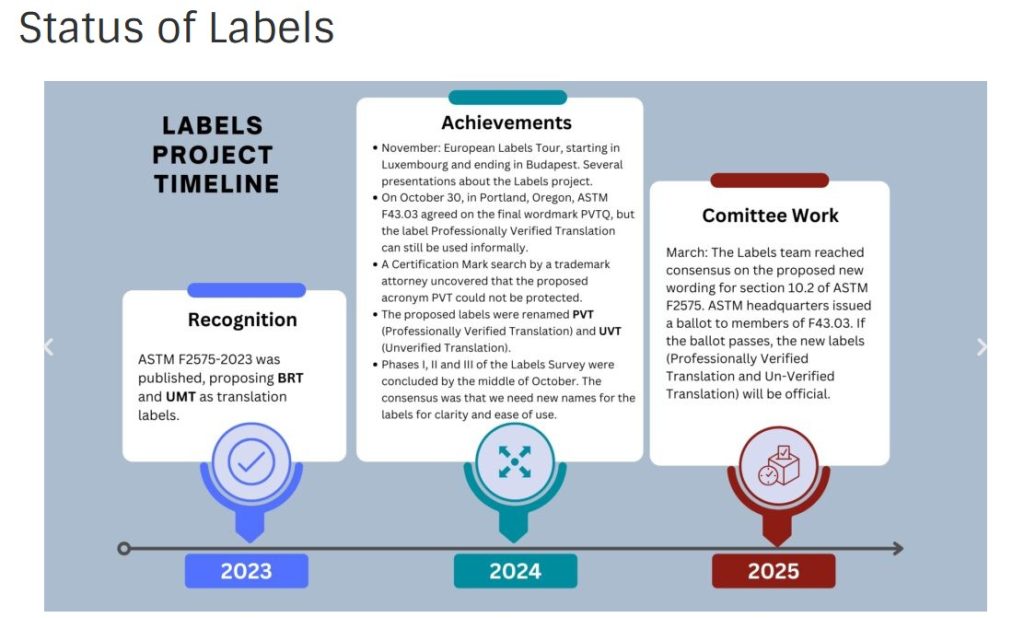
Under each ASTM high-level, consumer-oriented label, namely, Professionally Verified Translation (PVTr) and Unverified Translation (UVTr), there are three subtypes that tell more about the process that was used to produce the translation in question.
It is important to note that for each of the subtypes of Professionally Verified Translation, a qualified human takes responsibility for the output. What distinguishes PSC from HRH and fPEMT (see below) is directionality. Only PSC (produced and self-checked by a human) is source → target.
Directionality
As explained in Annex A1 of F2575, there is a fundamental difference between post-edited machine translation (aka automatic translation) and what is called in the translation spectrum “human translation” (HT). The difference is one of directionality (source to target vs target to source):
Human Translation starts from the source text and the target text is produced incrementally, while
Post-edited automatic translation starts from a complete target text, which is edited with the translator looking back at the source text.
The following excerpt from the current edition of the ASTM translation standard (F2575) shows that, in F2575, a “professional” is always a human. The graphic beside it unpacks the excerpt.
Subsection 10.2 of the 2025 edition of ASTM F2575
As a matter of transparency and consumer protection, stakeholders should label translation output as either “unverified translation” [UVTr] or “professionally verified translation” [PVTr]. The word “professionally” emphasizes that a professional — a qualified translator who has all the competencies mentioned in subsection 7.4 above (cf. ISO 17100:2015 subsection 3.1) — has produced and self-checked, edited, or revised (that is, verified) the translation, confirming that it meets the agreed-on specifications and is thus a quality translation. Any translation that is not professionally verified is considered unverified. After labeling, the translations are released for use.
In F2575, a qualified professional is necessarily a qualified human. A machine, no matter how capable, is never considered to be a professional.
- PSC – Produced and self-checked
- fPEMT – Full PEMT (post-edited machine translation)
- HRH – one human revising work of another
- nqHT – Human translation by a non-qualified individual
- Rgen AI – raw genAI translation or whatever comes next
- Raw (unedited) Neural Machine Translation or SMT